
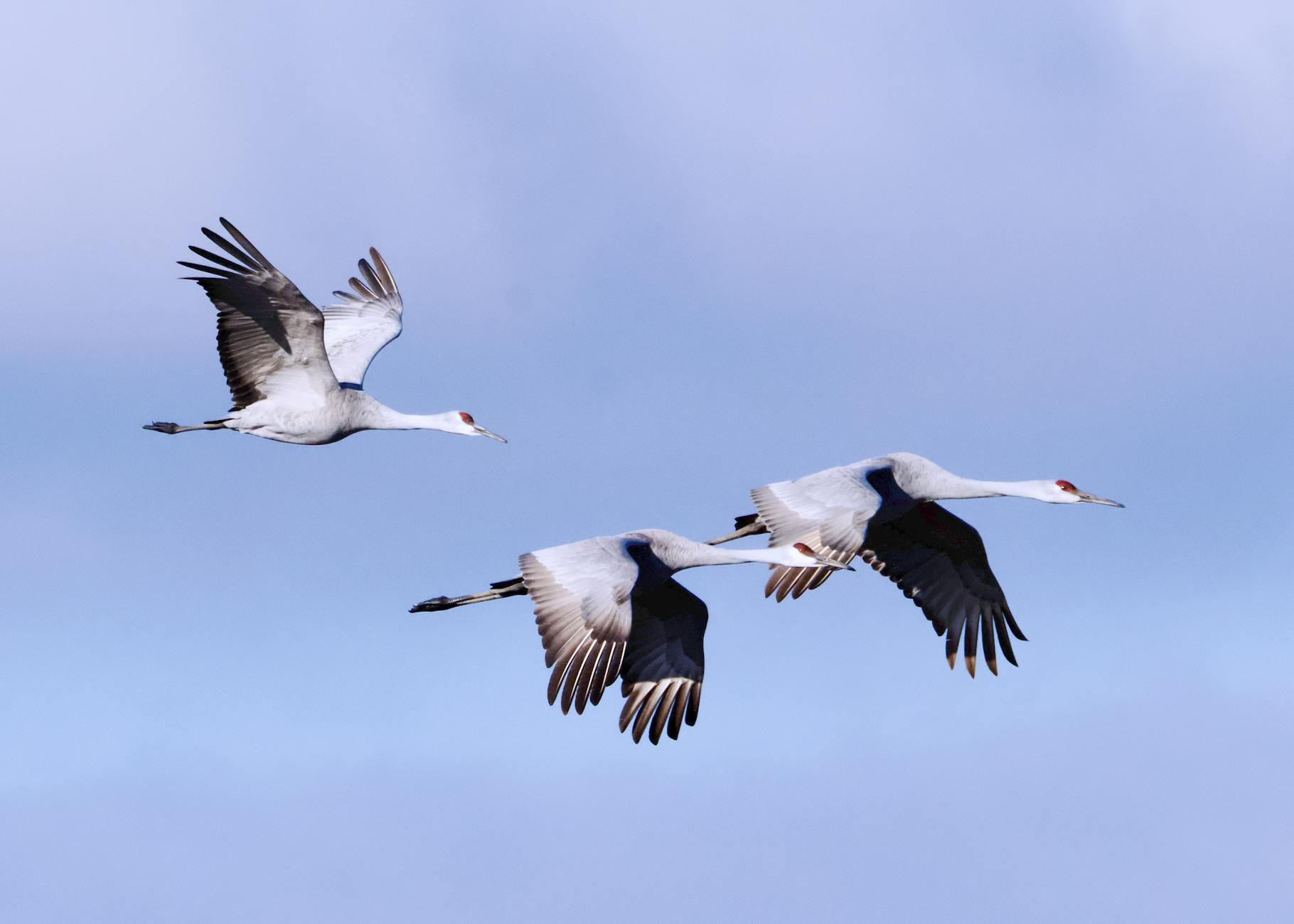
For months, I’ve carried the call of the Sandhill Cranes in my heart. They were passing over my home on an early Saturday morning as I was leaving to proctor the SATs at my high school. It was a divine interruption – a hard stop on the feverish rush of modern life. Since then, I’ve tried to force that experience into a Shakespearean sonnet, saving the cranes for the rhymed couplet at the end, but the form didn’t seem to fit and the lines felt forced. For example:
the kitchen faucet continues to drip
the mower ever refuses to start
the check engine light is teasingly lit
the dryer and fridge go suddenly dark
And so I abandoned the sonnet and took up the cinquain, as I mentioned in my last post. Specifically, the cinquain as imagined by Adelaide Crapsey. According to Poetry Foundation:
“With her invention of the cinquain, Crapsey created an American form similar to these Japanese predecessors. Like Ezra Pound, she admired the Japanese poets for their compressed language and formal aesthetics. The five unrhymed lines of the cinquain followed strict accentual-syllabic requirements. The lines consisted of two, four, six, eight, and two syllables (or accents), respectively. In addition to her preferred metrical scheme, Smith noted that Crapsey strove for a kind superposition of ideas similar to the “break,” or sudden perception of truth typically found in Japanese haiku.” (“Adelaide Crapsey”)
Rather than settle with a single cinquain, I opted for a single poem comprised of five cinquain stanzas. I have composed similar poems inspired by the haiku form, crafting a series of haiku vignettes back in 2015, and then merged the haiku with the villanelle in what I call a haikunelle in 2021. Here, then, is my quintet of cinquains inspired by my encounter with the Sandhill Cranes.
NOTE: For those unfamiliar with Sandhill Crane sounds, check out this link – https://www.allaboutbirds.org/guide/Sandhill_Crane/sounds
Crane Call
By Vincent H. Anastasi 2025
Above,
the Sandhill Cranes'
rattling bugle calls
lift me from life's numbing routines
to dream:

to fly
with feathered wings
above these busy streets
where gravity alone impedes
my flight;

to soar
in formation
and join the antiphon
and otherworldly canticle
of hope.

But dawn
slips into day;
responsibilities
gather in battalions. The cranes
have flown.

My thoughts
tumble quickly
back into the present,
but the rattling bugle calls
abide.


 the deepening ground
Leave a reply to v. anastasi Cancel reply